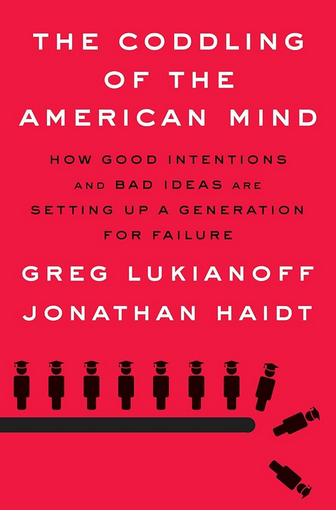
When Fragility Becomes a Creed: A Skeptical Review of "The Coddling of the American Mind"
Real argument: Campus culture has absorbed three “Great Untruths”-that fragility is virtue, feelings are facts, and people are good vs. evil, which harm learning and mental health. Solutions include cognitive behavioral tools, exposure to disagreement, and institutional norms that protect open inquiry. Verdict: Read-if you pair it with counterpoints. Useful frameworks; uneven evidence in places.
BOOKS
12/2/20255 min read


The Big Idea
The book argues that a set of well-intended beliefs—protect students from harm, trust feelings, divide the world into allies and enemies—has backfired. It has made young adults more anxious, less resilient, and campuses more brittle. The authors say the antidote is older wisdom (Stoicism), modern CBT, and institutional guardrails that encourage robust disagreement. The deeper claim: discomfort is a feature of education, not a bug.
What’s New Here (and Why It Matters)
Plenty of authors bemoan campus speech fights. This book tries to diagnose why they escalated: a moral elevation of safety into a quasi-religion, amplified by social media and risk-averse parenting. The “Great Untruths” are a sticky, testable lens you can apply beyond campus—to workplaces, activism, even family life. You’ll leave with practical tools (CBT drills, “steel-manning,” viewpoint-diversity habits), not just a litany of incidents.
Core Arguments / Plot Architecture (spoiler-safe)
Structure:
The three Great Untruths and their psychological costs.
How we got here: overprotective parenting, bureaucratic liability concerns, social media dynamics.
Case studies on campus controversies.
Prescriptions for students, parents, schools.
Key claims:
Treating people as fragile makes them fragile (antifragility matters).
Feeling offended isn’t decisive evidence of harm; challenge cognitive distortions.
Reducing complex conflicts to good vs. evil fuels intolerance and bad policy.
Evidence style: Social-psych findings, public incident databases, legal/administrative analysis, and news-driven case studies. Heavy on synthesis and narrative; lighter on original data.
Deep Dive
Frameworks & Models (and how to use them)
The Three Great Untruths
What doesn’t kill you makes you weaker → Avoidance raises anxiety.
Always trust your feelings → Feelings ≠ facts; test them.
Life is a battle between good people and evil people → Moral tribalism blocks learning.
Use: Before responding to a provocative idea, check: am I avoiding, absolutizing feelings, or demonizing?
Antifragility for Minds
Stressors—disagreement, critique, unfamiliar ideas—can strengthen cognition when dosed and reflected upon.
Use: Schedule “exposure sessions” to opposing views; debrief with written reflection.CBT Micro-Loop
Trigger → Automatic Thought → Label Distortion (e.g., catastrophizing) → Alternative Thought → Behavioral Test.
Use: One page per incident; repeat for a week. Track reduced reactivity.Viewpoint Diversity as Safety
Intellectual “safety” comes from norms and structures (clear speech policies, debate formats), not content bans.
Use: Adopt “steel-man first” rules in meetings; require written strongest-case summaries of opposing views.Social-Media Hygiene
Algorithms reward outrage.
Use: Default to app timers, no-phone seminars/meetings, and “48-hour rule” before public responses.
Evidence Check
Where it’s strong: Psychological mechanisms (exposure therapy logic, CBT efficacy); practical classroom/administrative norms; legal distinctions around speech.
Where it’s thin: Overgeneralizing from headline incidents; limited longitudinal data tying specific campus policies to national mental-health trends; heavy reliance on correlational patterns (social media rise ↔ anxiety). Survivorship and selection bias lurk in incident sampling.
Assumptions Under the Hood
Campus trends meaningfully drive or reflect broader youth mental health.
Exposure to offensive ideas reliably builds resilience for most students.
“Safetyism” explains more variance than structural or economic stressors.
These are plausible but not settled. Some contexts (severe trauma, discrimination) warrant accommodations; the book often treats those as edge cases.
Practical Takeaways
Run a CBT week: Log one triggering idea daily. Identify distortions, write an alternative thought, and re-expose (read, discuss, or write a response).
Steel-man by default: Before you counter, summarize the strongest opposing case to their satisfaction.
Design for friction: In classes/meetings, assign rotating “Devil’s Advocate” seats; publish discussion norms in advance.
Shrink the outrage window: Phone-free meetings + a 48-hour posting delay for institutional accounts on hot issues.
Teach norms, not vibes: Replace “be respectful” platitudes with concrete rules (no ad hominem, cite sources, time-boxed turns).
Parenting audit: More autonomy, less chauffeuring. Let teens solve problems with coaching, not rescue.
Institutional neutrality: When possible, refrain from official statements on contested politics; it preserves trust and reduces pressure to conform.
Contrarian Note
The book undervalues how real power differentials shape “open debate.” In some classrooms and workplaces, people self-censor for reasons that CBT can’t fix—grading authority, employment risk, or social penalties. Treating discomfort as therapeutic exposure can miss when the environment is actually punitive. Why it matters: leaders must pair discourse norms with accountability for abuse or bias; otherwise “free expression” becomes cover for the loudest.
Blind Spots & Risks
Elite-campus bias: Many examples come from selective schools; community colleges and non-U.S. contexts differ.
Intersectional evidence: Limited engagement with research on race, gender, and socioeconomic status in speech dynamics.
Over-medicalizing dissent: Labeling protective instincts as pathology can flatten legitimate claims of harm.
Causality creep: Social media, parenting, and policy effects intertwine; the narrative sometimes treats them additively without strong causal parsing.
Who Should Read This (and Who Shouldn’t)
Read if you are:
A dean/teacher crafting discussion policies.
A parent of teens navigating autonomy vs. safety.
A student leader tired of brittle debates and performative outrage.
An HR/learning lead importing campus-style norms into companies.
Skip if you want:
A partisan screed to confirm your side’s heroes and villains.
A quantitative meta-analysis with rigorous causal identification.
A granular legal handbook for policy drafting (use it as a starting point, not the final word).
How to Read It
Pacing: Two chapters a sitting; pause to test a tool (CBT, steel-manning) before moving on.
Skim vs. slow down: Skim repetitive incident case studies; slow down on the chapters explaining CBT, antifragility, and policy design.
Format: Print/ebook works; annotate with a “norms checklist” you can pilot in class or meetings.
Pairings: Read alongside counterpoints from student activists or speech-law scholars to stress-test the untruths framework.
Scorecard (1-10)
Originality: 7 - The “Great Untruths” frame is sticky and portable.
Rigor / Craft: 6 - Solid psych grounding; incident-driven evidence is uneven.
Clarity: 9 - Clean prose; arguments are easy to follow and apply.
Usefulness: 8 - Practical norms and CBT tools travel well beyond campus.
Re-read Value: 6 - Worth revisiting for frameworks; less so for cases.
If You Liked This, Try…
Kindly Inquisitors (Jonathan Rauch): A compact case for liberal science and speech norms.
The Righteous Mind (Jonathan Haidt): Moral psychology behind tribal politics and why we talk past each other.
So You’ve Been Publicly Shamed (Jon Ronson): Human-level look at online outrage and reputational collapse.
Difficult Conversations (Stone/Patton/Heen): Practical playbook for high-stakes dialogue at work and home.
The Anxious Generation (Jonathan Haidt): Phones, social media, and mental health—useful context even if you disagree.
FAQs
Q:Is the book political?
A:It critiques left-leaning campus norms more often, but its prescriptions (CBT, viewpoint diversity, institutional neutrality) are not inherently partisan.
Q:Does it blame students?
A:Partly, but more blame goes to incentives: risk-averse institutions, social-media dynamics, and well-meaning adults who overprotect.
Q:Can I apply this outside universities?
A:Yes. The norms, CBT tools, and steel-man habits fit workplaces, nonprofits, and family life.
Q:Is the evidence decisive?
A:No. It’s persuasive on mechanisms, mixed on macro causality. Treat it as a framework to test, not settled science.
Q:What’s one change a campus can make tomorrow?
A:Publish clear debate norms and adopt a “Chicago-style” free-expression statement, then train staff and student leaders to enforce process consistently.
Final Verdict
This is a sharp, useful framework for understanding why some institutions feel brittle and how to fix them without theatrics. Read it for the “Great Untruths,” the CBT micro-loop, and concrete norms you can deploy tomorrow. Don’t treat it as the last word on youth mental health or campus politics. Buy if you’re an educator, parent, or manager who wants tools over takes; borrow if you’re hunting for airtight causal proof.