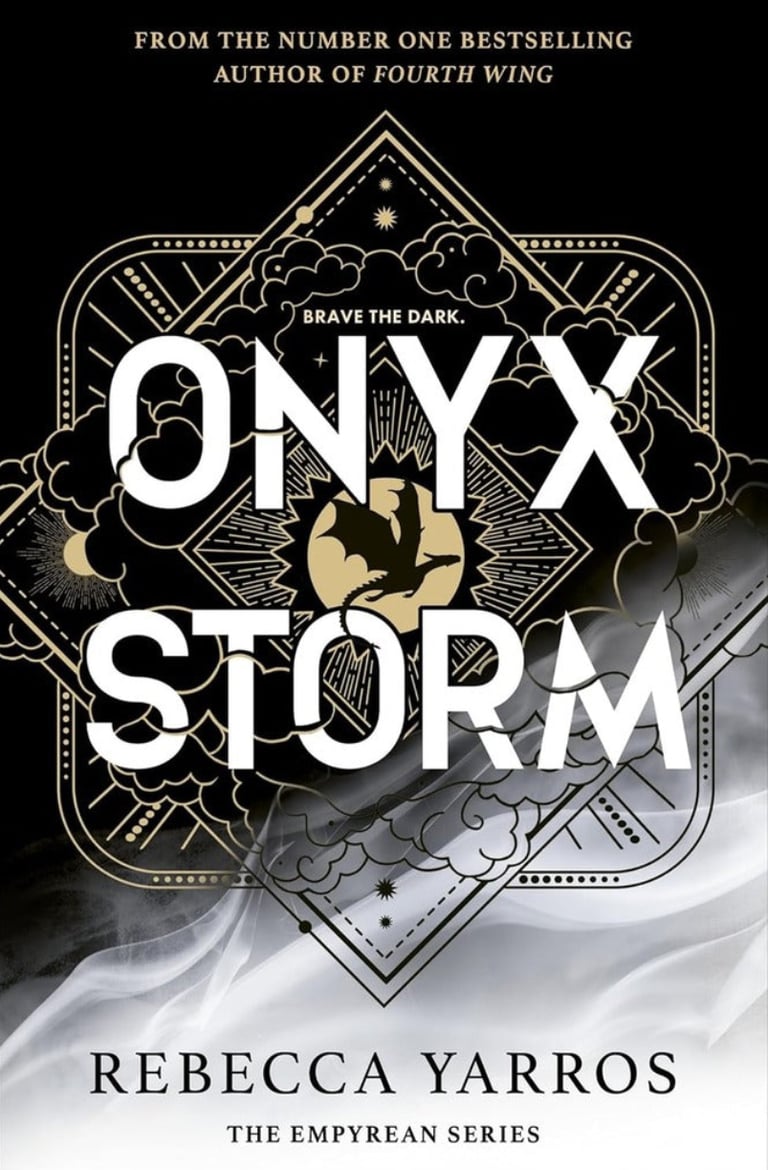
Dragons, desire, and decisions: a clear-eyed look at "Onyx Storm"
Real argument: Power isn’t just won in battles; it’s maintained through judgment, boundaries, and trust, especially when love and duty collide. Verdict: Read if you’re already in this world. Borrow if you’re romantasy-curious but allergic to cliffy momentum and plot-driven power jumps.
BOOKS
1/10/20265 min read
The Big Idea
This installment argues that surviving initiation is the easy part. Sustaining a fragile alliance—between humans, dragons, and rival factions—requires choices that are costly and public. The book leans into the problem most romantasy avoids: when private desire clashes with collective safety, which wins? It frames leadership as a daily grind of trade-offs, not a coronation.
What’s New Here (and Why It Matters)
Series momentum typically shifts from academy drama to geopolitics. Onyx Storm pushes further into the “after” of ascents—supply lines, strategy rooms, contested legitimacy—while still delivering heat and aerial combat. That balance matters: it’s where romantasy either grows up or dissolves into vibes. Here, the rider–dragon compact reads less like ornament and more like governance: a rule-bound relationship with teeth. You learn how loyalty—and its limits—shape not just couples, but coalitions.
Core Arguments / Plot Architecture (spoiler-safe)
Structure: Fast chapters, intimate point of view(s), a through-line of escalating stakes that toggles between combat, council, and relationship crucibles. Expect alternating pressure: external threat → internal fracture → partial repair.
Stakes: Survival of a fragile alliance; credibility of emergent leadership; the cost of secrecy in high-trust teams; the ethics of wielding bonded power.
Evidence (for fiction): Character choice under pressure; cause-and-effect visible in skirmishes and negotiations; recurring motifs (oaths, scars, wards, flight) that track growth and price.
Deep Dive
Craft & Technique
Voice: Contemporary, clean, and momentum-first. Dialogue carries worldbuilding; exposition arrives in short, digestible bursts.
Pacing: Front-loaded urgency, mid-book breathers, a late run of stacked decisions. When the romance slows the action, it does so to calibrate trust before the next hit.
World-building: Tactile and cinematic rather than encyclopedic. Politics are legible, not labyrinthine; the magic system clarifies at the edges and stays character-centric.
Character arcs: Protagonists wrestle with competing oaths—personal and public. Secondary players function as accelerants (pressure, counsel, betrayal), not lore-dumps.
Theme × Form
Alternating intensity mirrors the book’s thesis: private agreements determine public outcomes. A whispered promise can tilt a campaign.
Battle choreography showcases capability while forcing ethical choices (rescue one person or protect a formation?). Choices have downstream costs you can see.
Romance mechanics are not detachable subplots. Intimacy sequences reposition power and trust before the story cashes those checks in the next confrontation.
Memorable Moments (no spoilers)
A sky-high maneuver that works only because a rider respects—not commands—the dragon.
A council scene where an inconvenient truth is stated plainly and the room changes temperature.
A quiet ritual that reframes duty as chosen, not imposed.
Practical Takeaways
Oaths vs. preferences: List three promises you’ve actually made (to people, teams). Now list three preferences masquerading as promises. Adjust your calendar accordingly.
Command vs. consent: Before your next “ask,” write what the other party gains—explicitly. If you can’t, you’re managing, not leading.
Secrecy tax: Write the monthly cost (time, trust, miscoordination) of each secret you’re holding “for the greater good.” Decide which to retire first.
Capability under constraint: Define one constraint you won’t remove (budget, time, quality bar). Solve within it for a week. Watch focus improve.
After-action cadence: Post-project, answer: What did we intend? What happened? What will we change? Keep it to five bullet points, max.
Ritualize repair: Pick one small, repeatable act that signals “truce” after disagreements (walk, tea, check-in). Use it consistently.
Boundary sentence: Draft a single sentence you’ll say the next time duty and desire conflict. Practice it until it’s natural.
Contrarian Note
Power scaling still flexes to the needs of the plot. Abilities clarify or intensify when the story requires, not always when the worldbuilding argues they should. Why it matters: if you come for hard-magic rigor, you’ll notice the convenience. If you come for character-first stakes, it’s a tolerable trade.
Blind Spots & Risks
Logistics gloss: Campaign viability (food, distance, attrition) is streamlined. Tacticians may want more friction.
Moral compression: Big ethical choices resolve quickly to keep pace; some fallout underplays trauma.
Heat vs. strategy balance: Readers allergic to romantic intensity interrupting ops will feel whiplash. Others will argue that’s the point.
Villain opacity: Antagonist motives may read schematic in places; the book optimizes for pressure, not intricate ideology.
Who Should Read This (and Who Shouldn’t)
Read if you’re:
Invested in the Empyrean world and want the coalition-politics phase, not just the academy gauntlet.
A romantasy reader who wants dragons to matter as agents, not pets.
A book-club reader interested in leadership and consent framed inside fantasy stakes.
Maybe skip if you’re:
New to the series and hoping for a drop-in. Start earlier.
Expecting Brandon Sanderson-level systems or Abercrombie’s moral bleakness.
Seeking low-spice fantasy or purely court-intrigue plotting.
How to Read It
Order: Read prior installments first. The emotional ledger assumes earlier debts.
Pacing plan: Two to three sittings preserve momentum and memory of shifting alliances.
Skim vs. slow: Skim repeated internal spirals after major reveals. Slow down on council debates and oath-making—those scenes rewire later action.
Format: Audio works for tempo and tone; print helps flip back during strategy scenes and track names.
Scorecard (1–10)
Originality: 6 — Familiar romantasy scaffolding, stronger on consent-as-power.
Rigor / Craft: 7 — Tight pacing, coherent stakes; occasional convenient power jumps.
Clarity: 8 — Clean prose, clear scene objectives, legible politics.
Emotional Impact: 8 — Bonds and betrayals land; intimacy sequences shift strategy, not just mood.
Re-read Value: 6 — Payoffs track; surprises dim on return but craft holds.
If You Liked This, Try…
Rebecca Yarros, Fourth Wing / Iron Flame — Required foundation; the academy-to-war pivot starts here.
Naomi Novik, His Majesty’s Dragon — Dragon–human partnership as military doctrine.
Sarah J. Maas, A Court of Mist and Fury — Consent, trauma, and power inside a high-heat fantasy romance.
Rachel Hartman, Seraphina — Dragon–human tension with stronger court politics and music-of-the-mind worldbuilding.
Samantha Shannon, The Priory of the Orange Tree — Epic dragons with matriarchal politics; slower burn, broader canvas.
FAQs
Q:Do I need to read the earlier books first?
A:Yes. Emotional and political stakes assume prior knowledge.
Q:How “spicy” is it?
A:Medium-high. Romance scenes are integral to character and plot, not decorative.
Q:Is the magic system hard or soft?
A:Character-centric and situational. Expect clarity at the point of use, not encyclopedic rules.
Q:Any cliffhanger risk?
A:Expect unresolved threads. The arc advances but doesn’t tie every bow.
Q:Age range?
A:Adult romantasy with crossover YA energy in pacing and voice.
Final Verdict
Onyx Storm does what mid-series romantasy must: raise the stakes, deepen the bond, and make leadership cost something. It’s not hard-system fantasy and it won’t satisfy readers who need war logistics to drive every beat. But if you’re here for character-anchored strategy, consent as power, and dragons with agency—not window dressing—it delivers. Buy if you’re all-in on this world; borrow if you’re testing the waters.