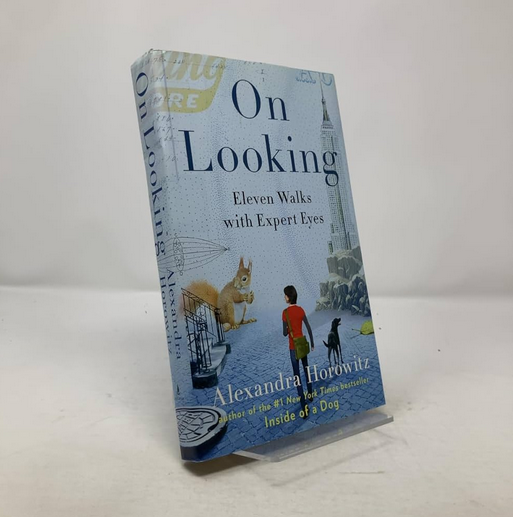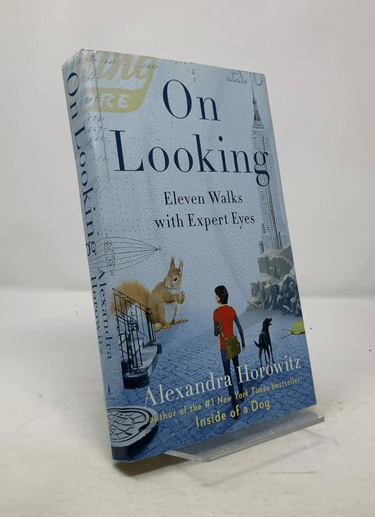
On Looking: How to See a Street Like Eleven Different People
Real argument: Attention is trained, not fixed. You miss most of what’s in front of you; borrow other people’s lenses to widen the frame. Verdict: Read for field-tested curiosity and practical drills; skip if you want a rigorous psychology textbook.
BOOKS
10/22/20255 min read

The Big Idea
Horowitz argues that everyday seeing is selective. We run on attentional autopilot and mistake that narrow feed for reality. Her fix is concrete: walk the same city block with people whose training tunes them to different signals; notice how the block changes with each lens. The book doesn’t aim to prove lab hypotheses; it aims to retrain your perception enough that your own street becomes strange, then legible.
What’s New Here (and Why It Matters)
Plenty of books praise “mindfulness.” This one operationalizes it. The novelty is method: multiple expert-guided walks that convert abstract ideas (inattentional blindness, sensory bias) into street-level exercises. You learn which signals your brain discards-and how to reconfigure what you notice without moving to a new city or buying gear. Comparators not provided.
Core Arguments / Plot Architecture (spoiler-safe)
Set-up: Our brains compress the world; most of perception is deletion.
The Walks: Repeat the same route with different guides (e.g., naturalist, geologist, sound-focused expert, child, person who is blind, dog). Each reveals a distinct layer-microfauna, stone and infrastructure, acoustic texture, wayfinding without sight, scent maps.
Synthesis: Attention is trainable through constraints and prompts; “seeing” is the product of habits plus context.
Evidence style: Anecdote-rich, research-informed; more field notes than formal experiments.
Deep Dive
Frameworks & Models
Lens Stacking:
Use: Dedicate short walks to single variables-material, motion, sound, text, edges. Do five micro-walks across a week; compare notes. Stacking reveals patterns (e.g., how noise maps to traffic geometry).
Scale Switching:
Use: Set a timer for two 5-minute passes: first at macro (block-level flows), then micro (cracks, lichens, marks). Alternate every corner. You’ll catch systems and anomalies.
Constraint Walks:
Use: Impose rules: no camera, no phone, no speech, or no straight lines. Constraints force new inputs; they also expose habitual shortcuts.
Sensory Rotation:
Use: On different days, lead with a single sense (sound, touch, smell). Sketch a crude sound map or scent trail; label sources and intensities.
Edge-Anomaly-Pattern (EAP):
Use: Train your eye to find edges (where materials meet), then anomalies (the thing out of place), then patterns (repeats across blocks). It’s a simple cue hierarchy that works for design audits and nature walks alike.
Field Log, Not Journal:
Use: After each walk, log three specifics (location, detail, inference). No prose, no feelings. This builds recall and keeps sentiment from drowning observation.
Evidence Check
Strong: The method aligns with established findings: attention is scarce; change blindness is real; sensory training shifts perception. The book’s demonstrations are replicable with zero budget.
Weak: It leans on anecdote; effect sizes, transfer across cultures, and durability of training aren’t quantified. Specialists may want tighter sourcing on cognitive claims. Treat it as a practice manual, not a meta-analysis.
Assumptions Under the Hood
You can walk your environment safely and with some time buffer.
Urban or walkable settings provide layered stimuli; rural readers will need to adapt (focus more on ecology and material layers).
You’re willing to be bored for the first 10 minutes while your attention reboots.
Practical Takeaways
Install a weekly loop: Same block, same day, different lens. Repetition is the teacher.
Draw a one-minute sound map: Circles for loudness, arrows for direction. Compare across weather and time.
Read the ground: Sidewalks and curbs archive city policy-patch patterns show utility work and maintenance priorities.
Borrow experts on demand: Walk with a friend in a trade (mason, gardener, teacher, cyclist). Ask them to narrate what jumps out; adopt one of their cues next time.
Hunt for “desire paths”: Unofficial foot trails reveal where design fails human intent. Photograph or sketch; propose a fix.
Use the EAP scan at work: Edges (handoffs), anomalies (bugs), patterns (recurring tickets). The street method generalizes.
Kid and dog lenses: If available, take a child or a dog. You’ll get scale, pace, and scent priorities you won’t invent yourself.
Micro-Playbook (print this)
Pick a one-block lab.
Choose tomorrow’s single lens (e.g., sound).
Walk 15-20 minutes, no phone.
Log 3 specifics (what/where/why it matters).
Repeat weekly; stack lenses; compare.
Contrarian Note
The book can romanticize noticing. Hyper-attention isn’t always good. There are days when tunnel vision is a feature-to ship, to focus, to get home. A more useful rule: modulate attention. Schedule wide-angle sessions (these walks) and telephoto windows (deep work). Constant vigilance is neither practical nor healthy.
Blind Spots & Risks
Urban bias: The template is city-centric; rural or auto-centric environments need translation.
Privilege of time & safety: Not everyone can meander with a notebook. The method undervalues constraints like caregiving, disability, or unsafe streets.
Selection bias: Expert lenses can create new blinders; a geologist’s city isn’t a sociologist’s city. Balance your stack.
Who Should Read This (and Who Shouldn’t)
Read if:
You make things for people-products, lessons, policies, art.
You want exercises, not just essays, to sharpen perception.
You enjoy fieldwork more than dashboards.
Skip if:
You need tight experimental claims and quant.
You want a narrative arc or memoir.
You dislike repeating routes or working from constraints.
How to Read It
Pacing: One chapter per day, then try the lens that day.
Skim vs. slow down: Skim anecdotes; slow down on the prompts and method.
Format: Print/ebook > audio (you’ll want to mark exercises).
Pairing: Keep a pocket notebook; treat it like lab work, not a vibe.
Scorecard (1-10)
Originality: 7 - Observation books exist; the multi-expert loop is a solid twist.
Rigor / Craft: 6 - Research-aware, anecdote-driven; method over measurement.
Clarity: 9 - Clean prose, concrete prompts.
Usefulness: 8 - High if you actually walk and log.
Re-read Value: 7 - Strong as a seasonal reset or for new cities.
If You Liked This, Try…
The Art of Noticing (Rob Walker): 131 prompts for attention training; more list-y, easy to deploy.
How to Do Nothing (Jenny Odell): Cultural critique plus attention ecology; theory-heavier, still practical.
Ways of Seeing (John Berger): Visual literacy with bite; short, foundational.
An Immense World (Ed Yong): Sensory worlds across species; expands what “seeing” can mean.
A Field Guide to Getting Lost (Rebecca Solnit): Essays on wandering and perception; lyrical counterpoint.
FAQ
Is this about dogs like Horowitz’s other work?
Dogs appear as a lens-useful to rethink pace and smell-but the focus is human observation.
Do I need a city?
No. The exercises translate: geologic layers, sound maps, edge scans work in suburbs and trails. Adjust lenses to context.
Will this make me slower at everything?
During walks, yes-and that’s the point. The gain is control: widen when exploring, narrow when shipping.
Is it kid-friendly or classroom-friendly?
Yes. The exercises adapt well to K-12: scale switching, sound maps, edge hunts.
Any gear required?
A notebook and a pen. Optional: a friend with a different background.
Final Verdict
Buy if you want a field manual that upgrades how you see-in work and in life-without pretending to be lab science. The expert-guided walks are simple, repeatable, and humbling; the city you thought you knew will multiply. If you need controlled studies or a tight storyline, borrow it-but try two lenses before you file it away. The street won’t change; you will.