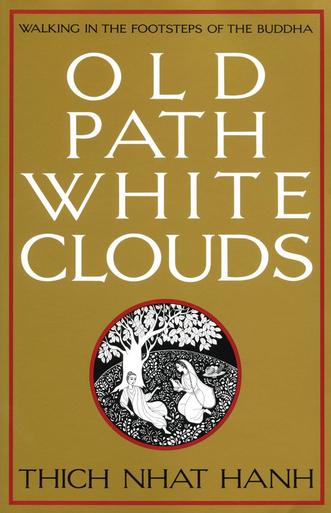
A Calm Biography That Doubles as a Practice Manual: "Old Path White Clouds"
Real argument: The life of the Buddha is a template for everyday compassion, attention, and non-attachment, not distant mythology but practical training for how to walk, speak, and act now. Verdict: Read if you want a serene, story-driven practice companion; skip if you need academic history or punchy productivity tactics.
BOOKS
12/16/20255 min read
The Big Idea
This is not just a cradle-to-parinirvana biography; it’s a manual for attention disguised as a life story. By following the Buddha’s travels, dialogues, and disputes, the book argues that liberation is local: breath by breath, step by step, word by word. It solves a common modern problem-spiritual abstraction, by turning lofty doctrine into repeated, ordinary actions. It doesn’t solve historical debates about dates, sources, or textual contradictions; that’s not its job.
What’s New Here (and Why It Matters)
Compared with standard introductions to Buddhism or brisk biographies, this book slows the camera down. It lingers on how to embody teachings in ordinary movements—walking, listening, cooking, speaking—rather than staying at the level of doctrines and lists. That framing matters if your goal is to live differently this week, not to pass an exam in Buddhist studies. Where a work like What the Buddha Taught parses concepts, this one stages them—giving readers a felt sense of equanimity, compassion, and non-fear by dramatizing them.
Core Arguments / Plot Architecture (spoiler-safe)
Structure: Episodic chapters that trace the Buddha’s life: renunciation, early students, teaching across regions, recurring challenges, and final instructions. Each episode doubles as a lesson on conduct—right view, right speech, right action—rendered through scenes.
Key claims:
Suffering is universal; freedom requires clear seeing and disciplined, humane action.
Mindfulness is not escape but engagement—paying honest attention to body, speech, and community.
Non-attachment isn’t apathy; it’s the only stable base for compassion.
Social conflicts—status, anger, fear—are workable with consistent practice, not miracles.
Evidence style: Narrative retellings drawn from canonical stories and commentarial traditions; emphasis on lived practice over historical footnotes.
Deep Dive
Frameworks & Models
Right Speech as a 4-Gate Filter: Is it true? Necessary? Kind? Timely?
Use it: Before a tough email or meeting, check all four; if any fail, revise or wait.Walking Meditation Protocol: One step per in-breath, one per out-breath; eyes soft; note contact of feet.
Use it: On corridors, parking lots, or a five-minute break between calls.Interbeing Lens: Everything conditions everything else; you can’t pull one thread without tugging the whole fabric.
Use it: Map one conflict (home or work) as a system: roles, triggers, incentives. Change one small, controllable node.Compassion with Boundaries: Help without fueling attachment or harm.
Use it: Offer concrete help with clear limits (“I can do X by Friday; after that, Y will need to pick up Z.”).Non-Fear Practice: Acknowledge loss and impermanence explicitly to reduce panic.
Use it: Name the fear (“This project may fail.”) and the plan for each outcome.
Evidence Check
Strong: Behavioral guidance is consistent with mindfulness-based interventions: attention training, mood regulation, de-escalation through breath and speech. The narrative format is sticky; you remember the practice because you remember the scene.
Weak: Sparse source criticism. The book doesn’t argue with historians, weigh Pāli vs. Sanskrit traditions, or litigate chronology. If you want textual apparatus and archaeological context, you’ll need to supplement.
Assumptions Under the Hood
Story can transmit ethics as effectively as doctrine.
Readers benefit more from practice prompts than from debates about textual redaction.
Compassion and clarity scale from personal life to civic life—speculative but practical.
Practical Takeaways
One-Meeting Rule: Start every team meeting with one minute of shared quiet. It lowers noise and reduces reactive speech.
Right-Speech Cheat Sheet: Keep “true, necessary, kind, timely” on your monitor. Apply before tense replies.
Micro-Retreats: Take two five-minute walking meditations per day; schedule them like calls.
Anger Cooling: Label sensations (heat, jaw, breath), extend exhale, delay response by 10 minutes.
Compassion + Boundaries Script: “I see you’re struggling. Here’s what I can do. Here’s what I can’t.”
Interbeing Mapping: For any recurring conflict, diagram causes across people and incentives; change one lever you own.
Loss Rehearsal: Write down one feared loss and what dignity looks like if it happens. Non-fear grows by rehearsal.
Contrarian Note
The serenity can feel like sanded edges. Real institutions—courts, hospitals, offices—run on deadlines and power, not on group mindfulness. The response here is implicit: practice doesn’t erase hard structures; it makes you steadier inside them. Fair, but readers should not confuse personal calm with structural change.
Blind Spots & Risks
Historicity: The book rarely flags where sources conflict or where a story is primarily hagiographic.
Social complexity: Structural injustice appears mostly as personal cruelty or ignorance; systemic analysis is thin.
Length & repetition: Meditative cadence can drag for readers wanting a brisk synthesis.
Translation variance: Without edition notes, tone and clarity can vary across translations.
Who Should Read This (and Who Shouldn’t)
Read if you’re:
New to Buddhism and prefer stories over doctrinal lists.
A stressed professional wanting a humane, non-performative practice.
A teacher, clinician, or manager looking for soft-skill frameworks rooted in ethics.
Maybe skip or pair with other texts if you’re:
Seeking rigorous academic history or philology.
Impatient with repetition or parable-driven pacing.
Looking for quick fixes or measurable “ROI” hacks.
How to Read It
Pacing: One or two chapters per day; treat each as a practice seed, not a binge.
When to slow down: Scenes that model speech and conflict resolution—those are the transferable skills.
When to skim: Repetitive travel itinerary once you’ve internalized the practice cues.
Format: Audio works for mood; print is better for marginalia and returning to practices.
Companion texts: Pair with a concise doctrinal guide if you crave structure.
Scorecard (1–10)
Originality: 7 - Well-known life retold as a living practice manual.
Rigor / Craft: 7 - Clear, steady prose; minimal historical apparatus.
Clarity: 9 - Simple language, accessible scenes, teachable moments.
Usefulness: 8 - Directly actionable in families and workplaces.
Re-read Value: 8 - Functions as a devotional/practice text; improves with slow rereads.
If You Liked This, Try…
Walpola Rahula, What the Buddha Taught — Doctrinal clarity to complement story.
Karen Armstrong, Buddha — A concise, historical biography with context.
Shunryu Suzuki, Zen Mind, Beginner’s Mind — Short chapters that train attention like muscles.
The Dhammapada — Core verses; terse reminders you can carry into daily life.
Pema Chödrön, When Things Fall Apart — Practical compassion for messy realities.
FAQs
Q:Is this a faithful history or a devotional retelling?
A:Primarily devotional and didactic—accurate to core themes, lighter on source disputes.
Q:Can a newcomer start here?
A:Yes. It’s a gentle on-ramp; you may later add a doctrinal overview for scaffolding.
Q:Will I learn meditation techniques?
A:Yes, in narrative form-walking, breathing, mindful speech-enough to start a daily rhythm.
Q:Is it suitable for secular readers?
A:If you can accept spiritual framing, the practices are secular-friendly and behavioral.
Q:How long is it, and is it dense?
A:Long but plain. The cadence is meditative; plan to read slowly.
Final Verdict
If you want scholarship, look elsewhere. If you want a calm, durable companion that turns Buddhist ethics into ordinary actions, this delivers. It’s long, occasionally repetitive, and light on historical sparring, but strong where most readers need help: speaking kindly, walking steadily, and responding to conflict without panic. Buy if you’re building a humane practice; borrow if you’re collecting footnotes.