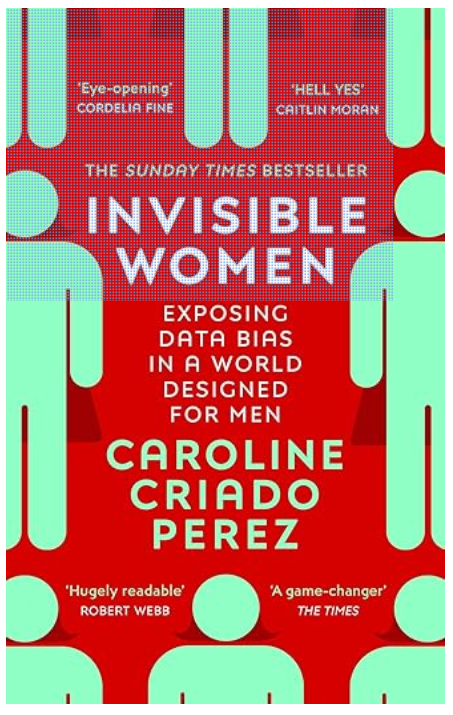
Invisible Women: When “Neutral” Data Isn’t-and What To Do About It
Real argument: Our products, policies, and research use a “default male” template. Missing or mis-specified data about women creates avoidable harm-from unsafe gear to bad medicine. Verdict: Read for a clear lens and practical redesign prompts; skip if you need narrow academic caution over broad synthesis.
BOOKS
10/21/20255 min read


The Big Idea
Invisible Women argues that the world is built on partial data. When the inputs ignore female bodies, time use, safety patterns, and caregiving realities, the outputs-policy, design, AI-predictably fail women. The book isn’t subtle: it stacks case studies until the “gender-neutral” myth looks absurd. The promise is a design brief, not a grievance list: measure properly, then build better.
What’s New Here (and Why It Matters)
The novelty is scope plus operational framing. Perez moves across medicine, transport, disaster response, tech, and workplaces to show the same root bug: missing, biased, or aggregated data. You won’t get new theory; you get a portable checklist for product and policy decisions. Comparators not provided.
Core Arguments / Plot Architecture (spoiler-safe)
Structure: Short chapters grouped by domain-public space, health, work, product design, algorithms, crisis response.
Key claims (nonfiction):
Women’s needs are treated as edge cases; design defaults are male.
Aggregated data hides differences (e.g., symptoms, travel patterns, injury risk).
“Add women later” is expensive and dangerous; measure up front.
Better data → better policy → better outcomes.
Evidence style: Government reports, NGO studies, academic papers, and case studies. Heavy synthesis, light methodological deep dives.
Deep Dive
Frameworks & Models
Sex-Disaggregated by Default (SDD):
Use: For every dataset or KPI, ask: do we collect by sex? If not, why? Apply to trials, safety tests, usage analytics, satisfaction, churn, injuries.
Five-D Lens for Decisions:
Data: What’s measured by sex (and where isn’t it)?
Design: Does the artifact fit diverse bodies/schedules?
Delivery: Are access channels safe and practical (lighting, childcare, shifts)?
Defaults: What “neutral” settings encode a male baseline (PPE sizes, office temps)?
Debrief: Who reviews outcomes by sex and fixes regressions?
Time-Use Reality Check:
Use: Map unpaid care and trip-chaining effects before planning transport or service hours. If women carry more unpaid work, off-peak access and proximity matter.
Risk Profile Split:
Use: Safety and health decisions should separate frequency from severity by sex (crash injuries, drug side effects). Optimize for both, not just averages.
Algorithmic Impact Review:
Use: For ML models, document training data sex balance, label definitions, false-negative costs, and conduct subgroup performance checks.
Evidence Check
Where it’s strong: Cross-sector pattern recognition; many examples with official sources; practical implications for design and policy are clear.
Where it’s thin / debated: Some cases are observational and context-specific. Effect sizes vary, and causality isn’t always nailed down. The book occasionally overgeneralizes high-income-country findings; intersectional breakdowns are uneven. Treat it as a directional brief, not a meta-analysis.
Assumptions Under the Hood
Collecting sex-disaggregated data is feasible and ethically acceptable.
Organizations will trade speed for measurement quality.
Differences are large enough to change design decisions (often true, sometimes marginal).
Binary sex categories are an adequate proxy in many contexts (increasingly contested; see Contrarian Note).
Practical Takeaways
Make SDD non-negotiable: In any team charter (policy, clinical, product), require sex-disaggregated collection and reporting—or a written exception.
Expand user testing: Fit tests across body sizes and shapes. For safety gear, test on the smallest and largest ends, not just median males.
Refactor “neutral” defaults: Office temps, tool grips, phone sizes, crash dummies, dosage baselines—assume the default is biased until proven otherwise.
Redesign service hours/locations: Align with trip-chaining and care loads (childcare pickup, off-peak windows, lighting and route safety).
Algorithm audits: Add subgroup performance metrics to your model card. Retrain or rebalance where female false-negatives spike.
Emergency planning: Evacuation, shelter, and relief logistics must include toilets, hygiene, privacy, and access to health products.
Budget for iteration: “Inclusive later” costs more. Ring-fence time and money for inclusive discovery up front.
Micro-Playbook (print this)
Pick one product/process. Add sex as a field in data capture (with clear privacy).
Run a fit-and-safety test on diverse bodies; log failures.
Publish a one-page SDD dashboard (inputs, outcomes, gaps).
Fix one biased default this month; log the delta.
Set a subgroup performance guardrail for any shipped model or policy.
Contrarian Note
The book mostly uses binary sex as the analytic unit. That’s often practical in medicine and safety-but it can miss gender-diverse users and intersectional effects (age, disability, ethnicity, income). The fix isn’t to abandon SDD; it’s to layer it: start with sex where biology matters, then add gender identity and intersecting variables where they change exposure, access, or risk.
Blind Spots & Risks
Privacy & consent: More granular data can expose users; guardrails matter.
Resource trade-offs: Disaggregation and expanded testing take time and money; teams will need prioritization criteria.
Global generalization: Some findings don’t travel; supply chains, culture, and infrastructure differ.
Metric traps: Counting women in studies isn’t the same as designing for outcomes; vanity metrics are easy.
Who Should Read This (and Who Shouldn’t)
Read if:
You own policy, product, research, AI, or clinical decisions.
You’re a city planner or operations leader tasked with service delivery.
You want a checklist to spot blind spots-fast.
Skip if:
You want narrow academic caution over applied synthesis.
You dislike cross-domain hopping and repeated pattern evidence.
You need randomized, causal studies for every claim.
How to Read It
Pacing: A domain per day; apply the checklist as you go.
Skim vs. slow down: Skim illustrative anecdotes; slow down on health, transport, and safety chapters- they map closest to life-and-death design.
Format: Print/ebook for margin notes and team excerpts; audio is fine but you’ll want to copy the checklists.
Team move: Book-club one chapter with engineering + policy + research in the same room; leave with one fix.
Scorecard (1–10)
Originality: 8 - Not new theory, but the cross-sector lens is rare and useful.
Rigor / Craft: 7 - Heavily sourced synthesis; causal precision varies.
Clarity: 9 - Plain language; examples stick.
Usefulness: 9 - Immediate design and policy implications.
Re-read Value: 8 - A reference when scoping studies or audits.
If You Liked This, Try…
Doing Harm (Maya Dusenbery): How medicine overlooks women-deep dive into diagnostics and care.
Data Feminism (D’Ignazio & Klein): Frameworks for equitable data practices; more theory, strong for teams.
Technically Wrong (Sara Wachter-Boettcher): Biased tech design and how to fix it.
Weapons of Math Destruction (Cathy O’Neil): When algorithms scale harm; complements the AI chapters.
The Second Shift (Arlie Hochschild): Time-use reality behind “neutral” workplace policies.
FAQ
Is this a data book or a polemic?
Both. It argues hard, but most chapters anchor on reports and studies. Use it as a starting map, then pull primary sources for your domain.
Will this help my team change anything real?
Yes-if you elevate SDD to a non-negotiable requirement and budget for discovery and testing. The book’s checklists translate into tickets.
Does it address non-binary and trans users?
Sporadically. It’s strongest on sex-based (biological) differences. Add gender identity and intersectional fields where relevant.
What industries should prioritize this first?
Healthcare, transportation, safety equipment, public services, and any AI/ML team making decisions about people.
Isn’t “neutral” simpler?
“Neutral” often means biased and brittle. Better measurement is cheaper than recalls, lawsuits, or public failures.
Final Verdict
Invisible Women is a use tool, not a coffee-table provocation. If you build or govern anything that touches bodies, time, or risk, it gives you a faster way to spot bugs in “neutral” assumptions and redesign with reality in mind. It over-generalizes at times, but the core directive lands: measure women properly, then design from the truth. For builders and policy people, that’s a buy.