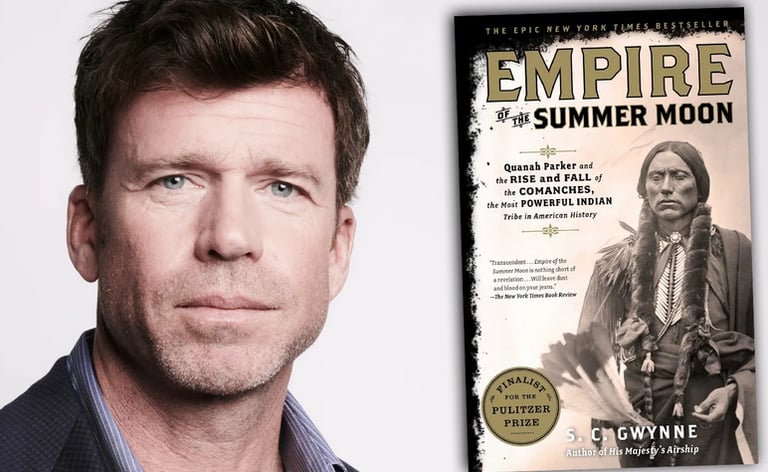
Horses, Power, and Myth-Making: A Hard Look at "Empire of the Summer Moon"
Real argument: The Comanche transformed North America through horse-powered mobility and raiding, built a regional empire, and were ultimately crushed by U.S. expansion, new weapons, and logistics. The story is framed around Quanah Parker and his mother, Cynthia Ann Parker. Verdict: Read-with caveats. Gripping narrative; uneven balance and dated tropes at times. Verdict: Read-if you pair it with counterpoints. Useful frameworks; uneven evidence in places.
BOOKS
12/3/20255 min read


The Big Idea
This is a story of advantage: how the horse turned the Comanche into the most feared power on the Southern Plains, and how industrial supply chains, new firearms, railroads, and relentless settlement stripped that edge. Gwynne anchors the arc in the lives of Quanah Parker and his mother, Cynthia Ann Parker, to humanize a centuries-wide collision. The book aims to explain why the Comanche dominated—and why they fell.
What’s New Here (and Why It Matters)
Plenty has been written about the “winning of the West.” Gwynne’s contribution is synthesis and pacing: he fuses military history, frontier memoirs, and biography into a tight narrative that reads like a novel. The focus on mobility as a system—breeding, training, scouting, and the operational use of horses—is especially useful. It reminds modern readers that “technology” isn’t only metal and silicon; it’s any repeatable edge that compounds. You’ll also get a clear, if one-sided, look at how terror, counter-terror, and retaliation escalated into a grim equilibrium.
Core Arguments / Plot Architecture (spoiler-safe)
Structure: Interleaved strands—Comanche ascent on the plains; the Parker family’s capture and aftermath; U.S. campaigns culminating in the Red River War; the reservation era’s pivot with Quanah Parker as a broker between worlds.
Claims:
The horse revolutionized Comanche life and warfare.
Geography (open prairie) + horsemanship outmatched Spanish, Mexican, and early U.S. settler tactics.
Industrialized logistics and weaponry shifted the balance late in the 19th century.
Evidence style: Period newspapers, military reports, settler accounts, and secondary histories. The tone is confident; the citations, while present, lean narrative over academic depth.
Deep Dive
Frameworks & Models (and how to use them)
Mobility as Technology
Treat movement—speed, surprise, withdrawal—as a compound advantage. In business or policy terms: if you move faster and with fewer constraints, you can choose the terms of engagement.Logistics Decide Outcomes
Cavalry raids flourish until supply chains, surveillance, and choke points (forts, railroads) neutralize them. Translation: the unglamorous back end—fuel, data, spares, roads—wins wars and markets.Asymmetric Adaptation
The side that reframes the fight (from set-piece battles to raids; later, to winter campaigns and herd destruction) sets the scoreboard. Strategy is a choice about where and how to compete.Myth vs. Archive
Gwynne’s narrative strength is also a risk. Use his story as a front door; then audit the archives he doesn’t foreground (Indigenous oral histories, Mexican records, environmental data).
Evidence Check
Strong: Operational detail on plains warfare; the lived texture of raids, scouting, and frontier skirmishes; the biography of Quanah Parker as a hinge between eras.
Weak: Limited Indigenous-language sources; sparse economic/demographic modeling (e.g., disease, trade flows); occasional “savage vs. civilized” echoes that modern scholarship has largely retired. Expect selection bias toward the most violent episodes—compelling on the page, but not a full ledger of daily relations, trade, or diplomacy.
Assumptions Under the Hood
That Comanche dominance was primarily a military phenomenon (underplays commerce and intertribal politics).
That U.S. expansion was historically inevitable (contestable).
That perspective from settler/military records can stand in for broader Indigenous viewpoints (a methodological gamble).
Practical Takeaways
Interrogate the Lens. Bestsellers are gateways, not endpoints. Pair this with Indigenous-authored or academic works to correct selection bias.
Study Mobility. Whether you’re running a team or learning history, map how speed, information, and terrain shape outcomes.
Respect Logistics. The “boring stuff” (supply, maintenance, winter campaigning) flips power dynamics.
Check the Baseline. Epidemics, climate swings, and horse ecology matter. Big arcs aren’t just leaders and battles.
Look for Brokers. Quanah Parker-type figures—bilingual, bicultural—often decide how empires fold into new orders.
Name the Myth. When a narrative leans on inevitability or moral binaries, label it. Then go find the grey zones.
Contrarian Note
The book sometimes frames Comanche violence as exceptional. That framing risks flattening context: state militaries, militias, and settlers also used terror, scorched earth, and hostage-taking. Singling out one side as uniquely brutal may make for cleaner storytelling, but it distorts cause-and-effect. Why it matters: readers unconsciously import those frames into how they view present-day conflicts and policing.
Blind Spots & Risks
Disease and demography: Pathogens and population shocks get less space than they deserve relative to battlefield drama.
Economics: Trade with New Mexico, the role of captured livestock, and cross-border markets are underdeveloped.
Indigenous voices: Limited use of oral histories and Native scholarship; women’s perspectives, outside Cynthia Ann Parker’s story, are thin.
Environmental constraints: Drought, grass cycles, bison herds, and horse ecology shape capacity; they’re backgrounded.
Who Should Read This (and Who Shouldn’t)
Read if:
You want a fast, vivid history of the Southern Plains and the Comanche wars.
You’re exploring how technology (even a horse) reorganizes society.
You can hold tension between a compelling narrative and its gaps.
Skip if:
You need an Indigenous-centered, methodologically rigorous study first.
You’re allergic to frontier-myth framing or graphic violence.
You want heavy footnotes, datasets, and historiographic debate on every page.
How to Read It
Pacing: One section per sitting; pause to cross-reference maps.
Skim vs. slow down: Skim repetitive raid descriptions; slow down on the transition to reservation life and the logistics of winter campaigns.
Format: Print or ebook with a map close by.
Pairings: Read alongside a corrective from Indigenous or academic voices (see below).
Scorecard (1-10)
Originality: 7 - Not a new topic, but the synthesis and focus on mobility land.
Rigor / Craft: 6 - Strong narrative craft; scholarly balance is mixed.
Clarity: 9 - Clean, forceful prose; scenes are easy to follow.
Usefulness (historical insight): 7 - Good frame for thinking about power, logistics, adaptation.
Re-read Value: 6 - Worth revisiting with counterpoints in hand.
If You Liked This, Try…
The Comanche Empire (Pekka Hämäläinen): A scholarly, systems-level reframe of Comanche power—trade, politics, ecology—not just warfare.
The Earth Is Weeping (Peter Cozzens): Broad, sober history of the Indian Wars with military and policy depth.
Bury My Heart at Wounded Knee (Dee Brown): Classic Indigenous-focused narrative; dated in parts but still a counterweight.
The Heart of Everything That Is (Bob Drury & Tom Clavin): Red Cloud’s rise; contrasts Northern Plains dynamics with the Southern story here.
FAQs
Q:Is the book accurate?
A:Broadly, yes on events and timelines; the weighting of sources leans settler/military, which can skew tone and emphasis.
Q:How violent is it?
A:Frank about raids, torture, reprisals, and massacres. If you’re sensitive to violence, expect tough chapters.
Q:What period does it cover?
A:Primarily 18th–19th centuries on the Southern Plains, climaxing in the 1870s campaigns and the reservation shift.
Q:Is this a biography of Quanah Parker?
A:Partly. His arc anchors the final third, but it’s not a full biography.
Q:Can I assign this for students?
A:Yes, with paired readings from Indigenous scholars to discuss framing, sources, and omissions.
Final Verdict
This is top-tier narrative history-urgent, propulsive, memorable. It’s also partial. Read it for the scene-setting and the clarity on how mobility built and unbuilt power on the plains. Then correct the lens with Indigenous-centered and scholarly work. If you want a gripping entry point into the Comanche story, buy; if you need methodological rigor first, borrow and pair it with a counterweight.