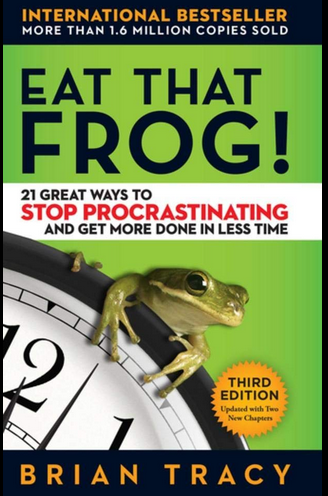
“Eat That Frog” for Grown-Ups: Do the Right Hard Thing First (Then Stop)
Real argument: Identify your highest-impact task and do it first, every day. Ruthless prioritization beats more hacks, apps, or hours. Verdict: Read for a crisp, no-nonsense prioritization playbook; skip if you need team-level systems or scientific rigor.
BOOKS
10/20/20254 min read

The Big Idea
The book’s premise is blunt: each day has one task whose completion creates disproportionate value. That task is unpleasant precisely because it’s consequential. Do it first, before email, meetings, or easy wins. Everything else-lists, apps, speed-is secondary to sequence. The problem it solves is diffusion: days lost to activity without progress.
What’s New Here (and Why It Matters)
None of the components are novel-prioritization, scheduling, focus-but the packaging is sticky: the “frog” metaphor cuts through resistance. You get a short catalog of rules (plan the day, 80/20, single-task, eliminate low-value work) that can be installed in one week. It matters because most productivity advice optimizes throughput; this book optimizes choice.
Core Arguments / Plot Architecture (spoiler-safe)
Structure: 20-odd short chapters, each a tactic: define goals, plan daily, apply 80/20, identify constraints, single-handle tasks, create deadlines, batch, say no, etc.
Key claims (nonfiction):
The most important task produces the bulk of results.
Planning the day in advance multiplies execution.
Single-handling (start → finish) beats task-hopping.
Creative procrastination: defer or delete low-value work by design.
Apply Pareto (80/20) and Parkinson’s Law (work expands) to compress effort into what matters.
Evidence style: Anecdote and commonsense reasoning; light on citations and experimental data.
Deep Dive
Frameworks & Models
Define the Frog (MIT Test):
Use: Ask: If I only finish one thing today, what changes the week? That’s the frog. Write it at the top of your planner the night before.
80/20 Sweep:
Use: List tasks. Mark the top 20% that drive 80% of outcomes. Delete, defer, or delegate the bottom 80% until the frog is done.
Time Blocking + Single-Handling:
Use: Reserve a 60–120 minute block, early. One task, no tabs, phone away. Finish a shippable unit (send, submit, publish).
Constraint Scan:
Use: Write the single bottleneck strangling progress (skill, person, approval, info). Attack that first; frogs often hide there.
ABCDE Prioritization (lightweight):
Use: Tag tasks A-E (A = must; E = eliminate). Do A1 first. If two As exist, the one you dread is likely A1.
Pre-Commit & Protect:
Use: Put your frog on your calendar and tell one person. Close the escape hatches: status off, calendar block, door closed.
Evidence Check
Strong: The sequence and focus ideas align with research on attention residue and switching costs; early-day deep work is widely effective.
Weak: The book offers minimal data, little nuance for team environments, and assumes autonomy. It leans on maxims more than field experiments; survivorship bias risk.
Assumptions Under the Hood
You control your calendar for at least one 60-120 minute block.
Output quality is rewarded more than responsiveness.
Your role has identifiable leverage points (not pure reactive support).
If these don’t hold, you need team-level fixes (norms for focus time, meeting hygiene) in addition to personal tactics.
Practical Takeaways
Night-before priming: Write tomorrow’s frog and prep the first move (file open, outline started).
Morning moat: First 90 minutes are offline. If the frog requires info, define the smallest shippable chunk you can still move.
Delete by default: Remove one recurring low-value task each week. If no one notices, it stays gone.
Batch communications: Two windows for email/DMs (e.g., 11:30 and 4:30). Outside those, notifications off.
Constraints first: If one permission blocks everything, schedule that request as today’s frog.
Define “done”: A one-sentence definition of completion prevents perfectionism creep.
Weekly review: Count frog days, not tasks. Aim for 4/5 weekdays with a completed frog.
Micro-Playbook (print this)
Pick tomorrow’s frog tonight.
Block 90 minutes before noon.
Remove two distractions (phone out of room, inbox closed).
Ship a complete unit and log it.
Kill one recurring low-value task this week.
Contrarian Note
“Do the hardest thing first” can backfire when your peak energy arrives later or when a small, quick win would unjam the bigger task. A smarter rule: do the most consequential thing in your peak window. If that’s 10 a.m. or 8 p.m., schedule accordingly.
Blind Spots & Risks
Team reality: The method underplays how meetings, SLAs, and managerial expectations crush morning focus.
Complex projects: Big frogs often hide multiple dependencies; without scoping, “start-to-finish” becomes fantasy.
Well-being: The book pushes output; it barely addresses rest or sustainable pacing.
Equity of focus: Caregivers and shift workers may lack control over early-day hours; adaptation is required.
Who Should Read This (and Who Shouldn’t)
Read if:
You own a backlog and can carve one protected block daily.
You want a short, implement-now method to escape busywork.
You like plain talk over theory.
Skip if:
Your day is 100% reactive and you cannot change it.
You want research-dense frameworks or org-level playbooks.
You already run a tight deep-work routine; this will feel basic.
How to Read It
Pacing: 1-2 sittings; implement one tactic per day for a week.
Skim vs. slow down: Skim motivational bits; slow down on prioritization, time blocking, constraints, and single-handling.
Format: Audio is fine; keep a notepad to choose tomorrow’s frog.
Pairing: Combine with a calendar and a physical to-do card you see all morning.
Scorecard (1-10)
Originality: 5 - Classic ideas with a memorable metaphor.
Rigor / Craft: 4 - Maxims and anecdotes; little data.
Clarity: 9 - Frictionless to understand and teach.
Usefulness: 8 - High if you truly protect the first block.
Re-read Value: 6 - Good as a quarterly reset when drift returns.
If You Liked This, Try…
Make Time (Knapp & Zeratsky): Friendly tactics for daily focus and energy.
Deep Work (Cal Newport): A sturdier philosophy and team-aware guardrails.
Atomic Habits (James Clear): Mechanics for building the morning moat and friction hacks.
The One Thing (Keller & Papasan): Singular-focus framing for long-term priorities.
FAQ
What exactly is a “frog”?
Your most valuable, most avoided task-the one that moves the needle.
What if my mornings are chaos?
Find your real peak and guard any 60-90 minute window. Negotiate team norms if possible.
How do I pick between two frogs?
Choose the one that reduces future work the most (unblocks others, closes loops, pulls revenue forward).
Is multitasking ever okay?
For shallow tasks, sure. For frogs, single-handle or you’ll bleed time to switches.
How soon will I notice results?
Often within a week-if you actually block the time and ship units.
Final Verdict
If you’re drowning in tasks, this book gives you one lever that actually moves the day: choose better, then commit early. It’s light on science and blind to team politics, but the core idea-sequence trumps speed-is hard to beat. Buy if you want a compact reset and can guard one daily block. Borrow if you already run a mature focus routine or need organization-wide change rather than personal tactics.