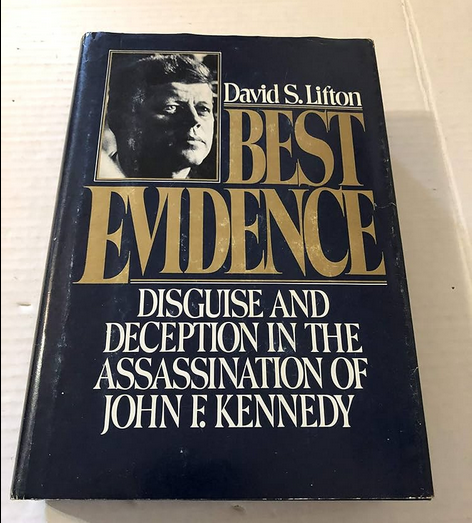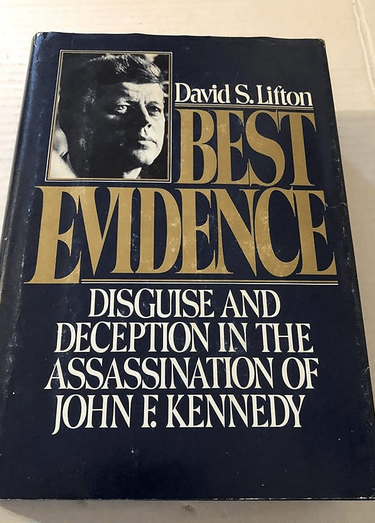
Did the JFK Evidence Get Altered? A Clear-Eyed Look at "Best Evidence"
Real argument: The medical and forensic record of JFK’s assassination was manipulated-specifically, that the president’s body was altered between Dallas and the Bethesda autopsy, to support an official narrative. Verdict: Borrow for methodology and controversy; skip if you want closure.
BOOKS
11/20/20255 min read


The Big Idea
Best Evidence reframes the JFK assassination as an audit problem. If the body is the ultimate data point, then whoever controls its chain of custody can shape the story. Lifton builds a case, through interviews, documents, and photographic disputes—that the “official” medical narrative cannot be trusted as presented. The book promises a forensic re-read of a national trauma. It struggles, however, to convert anomalies and contradictions into decisive proof.
What’s New Here (and Why It Matters)
Most JFK books re-litigate ballistics, shooters, or geopolitics. Lifton pivots to logistics: time stamps, transfers, witnesses in hospital corridors, casket swaps, autopsy prep. That shift matters because evidence isn’t just what it says; it’s how it moved. Even if you reject the conclusions, the lens is useful: interrogate custody and documentation before debating theory. You’ll learn how easily late, conflicting, or context-poor records can seed decades of doubt.
Core Arguments / Plot Architecture (spoiler-safe)
Architecture: The book proceeds chronologically, from Parkland Hospital in Dallas to Bethesda Naval Hospital—cross-cut with interviews of medical staff, military personnel, and handlers.
Key claims (summarized):
Chain-of-custody anomalies: Timing discrepancies in transport and arrival that, the author argues, permit unauthorized intervention.
Conflicting medical observations: Divergences between Parkland doctors’ descriptions and the Bethesda autopsy record.
Photographic and X-ray disputes: Challenges to official images’ interpretations and provenance.
Logistical feasibility: Windows of time in which alteration could have occurred.
Evidence style: Extensive interviews (often years after the fact), document excerpts, and reconstruction of timelines. The approach is prosecutorial; the tone is insistent.
Deep Dive
Frameworks & Models
Chain-of-Custody Map: Itemize every handoff (who/when/where). Flag gaps and overlaps.
Use it: For any investigation—corporate, legal, or historical—start with the custody ledger, not speculation.Anomaly Stacking vs. Smoking Gun: Distinguish cumulative suspicion from a single decisive proof.
Use it: Rate each claim (procedural lapse, memory variance, or genuine contradiction).Source Typology: Separate contemporaneous records, later interviews, and derived interpretations.
Use it: Weight sources by immediacy; mark all retrospective recollections with a reliability penalty.Timeline Compression Test: If an intervention is alleged, compute the minimum time, personnel, and access required.
Use it: Sanity-check feasibility before motive.
Evidence Check
Where it’s strong:
Granularity: Lifton’s catalog of timings, entrants, and artifacts forces careful reading of a chaotic day.
Witness breadth: Multiple institutional vantage points (ER doctors, Navy, Secret Service) provide cross-sections of the pipeline.
Methodological reminder: Custody gaps matter. That’s a durable lesson beyond JFK.
Where it’s weak:
Memory decay & suggestibility: Many interviews occurred years later; vividness ≠ accuracy.
Inference stacking: Anomalies are often tied together as if correlated; alternative benign explanations sometimes get short shrift.
Photographic disputes: Technical claims about photos/X-rays are contested by other analysts; few lay readers can adjudicate.
No direct documentary proof: The central allegation—body alteration—lacks a contemporaneous, unambiguous record.
Bottom line: The book raises fair questions about process; it doesn’t close the case.
Assumptions Under the Hood
A complex intervention was possible under federal protection without ironclad documentation emerging.
Multiple actors could coordinate in real time amid national chaos.
Institutions would maintain secrecy for decades.
If any of these strike you as improbable in the aggregate, your prior will be skeptical.
Practical Takeaways
Lead with logistics: In controversies, build a minute-by-minute ledger before diagnosing motives.
Weight sources by proximity: Prioritize contemporaneous notes over late interviews; label each block of evidence by type.
Beware narrative glue: Don’t let a theory harden just because it neatly explains anomalies.
Run feasibility math: For any alleged intervention, list tasks, actors, and minimum time; if the math doesn’t work, the story doesn’t either.
Separate “known unknowns” from speculation: Maintain a table: confirmed, contested, plausible, unsupported.
Compare like with like: Medical descriptions from different settings (ER resuscitation vs. post-mortem exam) can differ for non-nefarious reasons.
Document the alternative: If you reject the official account, articulate a rival, testable chronology-not just doubts.
Contrarian Note
The book tends to treat bureaucratic inconsistency as intention. But large systems generate contradictions on their own, especially under crisis. The more moving parts, the more error bars. Before elevating anomalies to conspiracy, discount for chaos: multiple caskets, redundant transports, imperfect comms, and human shock can all produce mismatched memories and paperwork.
Blind Spots & Risks
Ethical risk: Heavy insinuation can implicate real people without conclusive proof.
Base-rate neglect: Extraordinary coordination is assumed; the baseline probabilities of mundane error aren’t modeled.
Selective attention: Emphasized accounts can crowd out equally credible but exculpatory testimony.
Method variance: Medical observations made under resuscitation vs. autopsy are not methodologically equivalent—yet they’re often compared as if they were.
Who Should Read This (and Who Shouldn’t)
Read if you are:
A researcher who wants the chain-of-custody lens on historical events.
A journalist learning how small logistical seams can reshape narratives.
A JFK-case completist who tracks every major argument, including heterodox ones.
Skip (or skim) if you want:
A consensus, mainstream narrative without heavy contention.
A short, accessible introduction to the case.
A definitive resolution rather than an extended cross-examination.
How to Read It
Suggested pacing: One major section per sitting; take notes.
Where to slow down: The Dallas-to-Bethesda transport timeline and the autopsy documentation chapters.
Where to skim: Extended disputes over arcane photographic details if you lack technical background, note the claim, skip the rabbit hole.
Format: Print or e-reader with annotation. Keep a separate timeline spreadsheet for clarity.
Counterpoint reading: Pair with mainstream rebuttals and pro-conspiracy alternatives to calibrate your own priors (titles listed below).
Scorecard (1-10)
Originality: 8 - The custody-audit lens is distinctive.
Rigor / Craft: 5 - Industrious but leans on late memories and inference chains.
Clarity: 6 - Detail-rich; at times density blurs signal.
Usefulness: 6 - High for method; low for closure.
Re-read Value: 5 - Reference value if you’re researching; otherwise heavy.
If You Liked This, Try…
Gerald Posner, Case Closed - Mainstream defense of the lone-gunman view; clean counterpoint.
Vincent Bugliosi, Reclaiming History - Massive synthesis arguing against conspiracy; procedural context.
Josiah Thompson, Six Seconds in Dallas - Forensic emphasis on timing and shots; classic case-study lens.
Sylvia Meagher, Accessories After the Fact - Early, meticulous critique of the Warren Commission’s evidentiary gaps.
Jim Garrison, On the Trail of the Assassins - A window into prosecutorial conspiracy framing (and its pitfalls).
FAQs
Q:What’s the central thesis in one line?
A:That the medical record was manipulated—possibly via body alteration—between Dallas and Bethesda, undermining the official narrative.
Q:Do historians accept Lifton’s conclusions?
A:Largely no. The mainstream view disputes the feasibility and relies on contemporaneous documents and alternative expert analyses. The debate persists in specialist circles.
Q:How reliable are decades-later interviews?
A:Useful for leads, risky for facts. Memory is reconstructive; without contemporaneous corroboration, treat such testimony cautiously.
Q:How is this different from other JFK books?
A:It prioritizes logistics and custody over ballistics and geopolitics, reframing the problem as an audit rather than a whodunit.
Q:Is it still worth reading in 2025?
A:Yes, if you study how narratives form from messy records. Not if you want a concise, conclusive history.
Final Verdict
Best Evidence is ambitious, granular, and relentlessly suspicious. It reframes the case as a logistics problem and forces you to respect custody and context. It also leans hard on brittle memories and inference ladders without delivering a smoking gun. If you investigate complex events or teach others how to read records, borrow it for the method and the cautionary lessons. If you’re hunting for definitive answers, skip and consult mainstream syntheses instead.