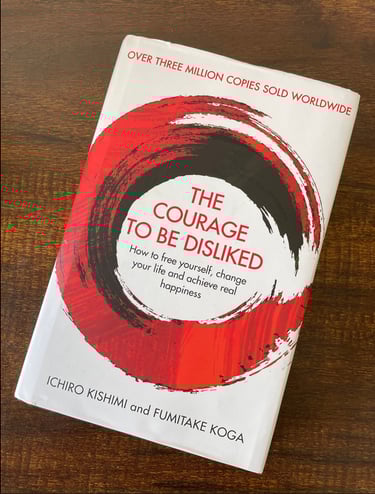
Freedom Over Approval: A Hard-Nosed Review of "The Courage to Be Disliked"
Real argument: Your suffering isn’t destiny. You can choose goals, act on them now, and stop outsourcing self-worth to other people’s approval, an Adlerian take delivered as a dialogue. Verdict: Read for a clear, usable reframing toolset; skip if you need data-heavy psychology or step-by-step clinical techniques.
BOOKS
12/15/20255 min read
The Big Idea
This is practical philosophy wearing a self-help jacket. The book channels Alfred Adler’s individual psychology to argue that most everyday misery comes from chasing approval and misassigning responsibility. The antidote is to live by tasks you own, contribute to community, and accept the “cost” of freedom—some people won’t like you. It solves the common problem of people-pleasing paralysis and rumination. It doesn’t solve trauma treatment or systemic barriers.
What’s New Here (and Why It Matters)
Plenty of books say “care less what others think.” This one shows how: reframe problems teleologically (by purpose) rather than by cause, and separate tasks ruthlessly. The novelty isn’t new research; it’s a crisp, operational translation of Adler: self-acceptance → responsibility → contribution. Compared to standard habit books, this goes deeper on interpersonal freedom; compared to therapy memoirs, it’s more actionable for daily decisions. If you keep asking, “What if they’re disappointed?” this book hands you a knife: cut the cord where their feelings are their task.
Core Arguments / Plot Architecture (spoiler-safe)
Format: A Socratic dialogue between a philosopher and a frustrated young man across several conversations.
Claims:
Your past doesn’t fix your future; you act for goals, not because of causes.
Most interpersonal pain = approval addiction.
Tasks have owners. Confusion breeds resentment and control games.
Live horizontally (as equals), not vertically (status hierarchies).
Community feeling (belonging via contribution) is the healthiest source of meaning.
Evidence style: Philosophical argument, everyday examples, Adlerian concepts; light on citations or experimental data.
Deep Dive
Frameworks & Models
Teleology over Causality: Ask, “What outcome is this behavior serving?” Instead of excavating every childhood cause, identify the function (e.g., procrastination protects you from judgment).
Use it: Name the payoff. Pick a better payoff. Change the behavior.Separation of Tasks: Whose job is it? Your effort is yours; another’s approval is theirs.
Use it: For any thorny issue, draw two columns: mine / theirs. Act only in mine.Horizontal Relationships: Treat peers as equals; drop covert status games.
Use it: Replace evaluation (“Are they above/below me?”) with cooperation (“What problem are we solving?”).Self-Acceptance → Self-Reliance → Social Interest: Accept limits, rely on your choices, contribute beyond self.
Use it: Each day: one acceptance, one choice, one contribution.
Evidence Check
Strong: The tools fit modern cognitive-behavioral practice in spirit (identify functions, adjust beliefs, change behavior). The dialogue format lowers the barrier to use.
Weak: Minimal empirical scaffolding. Trauma, neurodiversity, and socioeconomic stressors are underdeveloped. Complex clinical realities risk being flattened into “choose differently.”
Assumptions Under the Hood
People can choose goals independently of past causes.
Social approval is a net negative driver versus contribution.
Most conflicts are task confusion rather than structural constraints.
If any of these wobble-severe PTSD, coercive workplaces, fragile safety nets-the model needs bolting to real resources and rights.
Practical Takeaways
Daily Task Audit (5 minutes): List today’s top 3 tensions. For each, mark mine/theirs. Drop anything in theirs.
Outcome Swap: For a sticky habit, write the hidden payoff. Pick a new payoff that beats it (e.g., “protect pride” → “ship work to learn faster”).
Approval Detox: For one week, replace “Will they like it?” with “Is this my task? Does it contribute?”
Horizontal Meeting Rule: Ban status talk (titles, tenure posturing). Open with the shared problem definition.
Contribution Reps: Do one small, anonymous helpful act daily. Train the brain to prize contribution over applause.
Boundary Script: “That part is yours; here’s what I’ll do.” Repeat without apology.
Normal Is Fine: Say no to an ego-boosting but misaligned project. Write one sentence on what you’ll do with that reclaimed time.
Contrarian Note
The book’s stance that the past doesn’t matter (in practice) can read as a dodge. For many, past events shape nervous systems and access to choices. Telling people to “choose” without acknowledging constraints risks blame. The cleaner version: start where you are, but don’t deny where you’ve been.
Blind Spots & Risks
Trauma literacy: Little guidance on when to seek clinical care.
Power & systems: Limited attention to environments that punish boundary-setting (e.g., precarious work).
Cultural variance: “Being disliked” has different stakes across families, genders, and cultures; the book generalizes.
Evidence base: Philosophically coherent, empirically light—know what you’re buying.
Who Should Read This (and Who Shouldn’t)
Read if you’re:
A manager or creator tangled in people-pleasing and overcommitment.
A reader who likes Stoic-flavored, tools-first psychology.
Someone craving a vocabulary for boundaries that isn’t combative.
Maybe skip (or pair with other texts) if you’re:
Seeking trauma-informed methods or diagnostics.
In a high-control context where “being disliked” carries serious costs.
Wanting data-driven psychology with randomized trials and protocols.
How to Read It
Pacing: One conversation per sitting; apply one tool before reading further.
Slow down on: Separation of tasks and horizontal relationships—these are the workhorses.
Skim if needed: Repetitive parables once you’ve internalized the model.
Format: Audio works; take notes for the task audit.
Pair with: A CBT workbook or ACT guide for structured exercises if you want evidence-based scaffolding.
Scorecard (1–10)
Originality: 7 - Adler reframed accessibly; not brand-new, but fresh in delivery.
Rigor / Craft: 6 - Clear logic; light on empirical grounding.
Clarity: 9 - Simple language; memorable constructs.
Usefulness: 8 - Immediate boundary and decision tools.
Re-read Value: 7 - Short, quotable; worth revisiting during boundary drift.
If You Liked This, Try…
William B. Irvine, A Guide to the Good Life — Stoic practices that complement task separation.
Oliver Burkeman, The Antidote — Against positivity; tolerating discomfort to act.
David D. Burns, Feeling Good — CBT techniques if you want evidence-based homework.
Greg McKeown, Essentialism — Saying no with a system; aligns with owning your tasks.
Acceptance and Commitment Therapy (any solid workbook) — Values-led action with clear exercises.
FAQs
Q:Is this really Adlerian psychology or pop-Adler?
A:It’s Adler through a modern, practical lens. Purists may quibble; the core ideas track Adler’s emphasis on goals, social interest, and equality.
QWill this replace therapy?
A:No. It’s a helpful lens. Complex or persistent distress warrants qualified care.
Q:What exactly is “separation of tasks”?
A:Clarifying responsibility. You control your efforts and choices; others own their reactions and choices.
Q:Is “being disliked” the point?
A:No. Tolerating some disapproval is the cost of acting by your values, not a goal.
Q:How do I apply this at work without getting fired?
A:Start small: clarify responsibilities, document decisions, frame boundaries around shared goals. Escalate to structural fixes (role design, staffing) where needed.
Final Verdict
This book is a boundary-setting toolkit posing as a parable. If you’re stuck chasing approval or drowning in other people’s expectations, the Adlerian frame—especially separation of tasks—is sharp, memorable, and immediately usable. It underplays trauma and structure, so pair it with evidence-based resources if that’s your landscape. For most reflective professionals: buy and mark it up. For data purists: borrow, extract the tools, and move on.