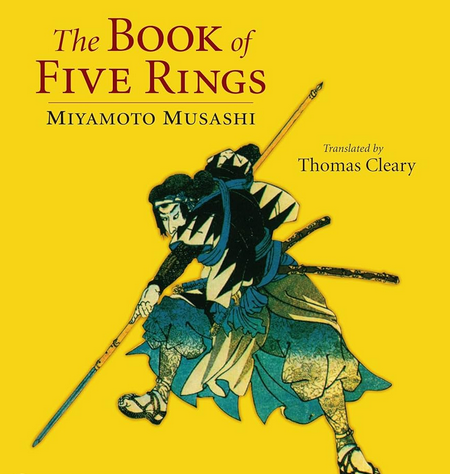
Sharp Edges, Quiet Mind: A Pragmatic Review of "Book of Five Rings"
Real argument: Mastery is ruthless attention to timing, distance, and intent—whether in swordplay or strategy. Verdict: Read. Short, spiky, usable-if you translate metaphors into drills.
BOOKS
11/30/20255 min read


The Big Idea
Musashi wrote a manual for winning under pressure. Strip away the swords and you get a systems view of conflict: understand terrain (context), control distance (options), seize timing (initiative), break rhythm (surprise), and cultivate emptiness (non-attachment to plans). The promise is clarity under stress. The risk is romanticizing aggression without guardrails.
What’s New Here (and Why It Matters)
Compared to boardroom staples, Musashi is brutally operational. No motivational fluff. No case studies. Just field-tested heuristics from someone who bet his life on them. Where other classics (see The Art of War) favor grand strategy, Five Rings drills the micro—the beat-to-beat mechanics of gaining advantage. This is useful if you operate in messy, high-variance environments where speed, signal detection, and adaptability beat elaborate plans.
Core Arguments / Plot Architecture (spoiler-safe)
Structure: Five short “books” (rings)—Earth, Water, Fire, Wind, Void.
Earth: Foundations—stance, grip, posture, mental attitude.
Water: Adaptability—shape yourself to the situation.
Fire: Combat tempo—pressure, aggression, breaking rhythm.
Wind: Critique of other schools—don’t fetishize style.
Void: Direct perception beyond technique—act from emptiness.
Evidence style: Anecdotal and prescriptive. Musashi asserts; he doesn’t argue stats. The authority is experience.
Deep Dive
Frameworks & Models (plain-English, field-usable)
Distance × Timing (Maai × Hyōshi): Think in two axes.
Distance = the space of options; too close or too far both limit you.
Timing = when you move; a late “right move” is wrong.
Use it: Before any key move (pitch, trade, escalation), check: Do I have room? Is the rhythm mine? If not, fix spacing first, then act.
Seize Initiative (Sen no sen / Go no sen): Take over the tempo before the other side completes theirs—or counter exactly as they commit.
Use it: In negotiation, introduce your framing early (sen no sen). If forced to defend, counter on their commit, not after (go no sen).
See Widely, Strike Narrowly: Keep panoramic awareness; execute one precise action.
Use it: Run a wide-scope scan (market, stakeholders, risks), then choose one decisive lever. Don’t spray effort.
Break Rhythm: If the opponent synchronizes to you, you’re predictable. Change cadence, angle, or tool.
Use it: In product or ops, alter release timing, pricing cadence, or communication channels to reset expectations.
Two-Sword Principle: Be ambidextrous in tools and roles.
Use it: Leaders must operate at two levels—hands-on and strategic. Schedule time blocks for each mode; don’t conflate them.
Void (Emptiness as Operating Mode): Drop attachment to style, ego, or prior success.
Use it: Run pre-mortems; kill beloved features; test against counter-evidence. Emptiness = freedom to pivot.
Evidence Check
Strengths: Coherent internal logic, forged in high-stakes practice. The guidance is modular and stress-tested.
Weaknesses: Zero empirical data; survivorship bias (we hear from the winner); cultural context limits portability. Interpret as heuristics, not universal laws.
Assumptions Under the Hood
The situation is adversarial and zero-sum.
Speed plus decisiveness outperforms consensus-building.
Individual agency matters more than institutional constraints.
If your arena is cooperative, regulated, or path-dependent, adjust accordingly.
Practical Takeaways
Pre-move checklist (60 seconds): Terrain? Distance? Timing? If you can’t answer, you’re guessing.
Own first framing: Start meetings by naming the problem and success criteria in one sentence. That’s “sen no sen.”
Cadence control: If you’re reacting to others’ calendars, you’ve lost tempo. Set your own release/decision rhythm.
Wide-then-narrow ritual: Two minutes of panoramic notes → one line: “Given all this, we do X now.”
Break patterns deliberately: If your playbook stops working, change angle—audience, message, channel, or timing—before pumping more effort.
Tool ambidexterity: Keep two execution modes live each week: craft mode (deep work) and command mode (coordination). Protect both on the calendar.
Void drills: Run a weekly “ego strip”: cancel one activity done for optics; ship one change you’ve resisted because it breaks your style.
Contrarian Note
Musashi pushes decisive dominance. In complex systems, over-assertion backfires. Sometimes the winning move is not to seize initiative but to widen the game, create slack, or let others reveal their preferences. Aggression is a tool, not a virtue. Treat “press the attack” as an option in a portfolio, not a default.
Blind Spots & Risks
Ethics are assumed, not discussed: “Winning” is abstract; aims aren’t interrogated. You need your own red lines.
Team dynamics: The text is solo-operator heavy. Cross-functional alignment is thin.
Selection bias: Techniques from lethal duels don’t map 1:1 to multi-stakeholder environments.
Translation variance: Key terms (timing, rhythm, void) shift meaning across editions; your mileage will vary.
Who Should Read This (and Who Shouldn’t)
Read if you are:
A founder, negotiator, athlete, or operator who performs under pressure.
A product or security lead dealing with adversaries and fast cycles.
A learner who prefers terse, drillable principles over stories.
Skip (or just sample) if you want:
Data-backed behavioral science or modern case studies.
Collaborative playbooks for large bureaucracies.
Motivational prose or therapeutic framing.
How to Read It
Pacing: One ring per sitting; annotate.
Skim vs. slow down: Slow down on Earth (foundations) and Void (mindset). Wind (criticisms of other schools) can be skimmed if you’re not into koryū debates.
Format: Print wins; margin notes matter.
Practice loop: After each ring, convert one idea into a weekly drill (timing, cadence, pattern-breaking).
Scorecard (1-10)
Originality: 9 - A distinct, field-born perspective on strategy.
Rigor / Craft: 7 - Internally coherent; empirical rigor is thin by design.
Clarity: 8 - Stark, compact aphorisms; translation affects sharpness.
Usefulness: 9 - High if you convert to drills; low if read passively.
Re-read Value: 9 - Grows with your responsibilities and risk exposure.
If You Liked This, Try…
The Art of War (Sun Tzu): Macro strategy and deception to balance Musashi’s micro.
Hagakure (Yamamoto Tsunetomo): Bushidō ethics and decisiveness—philosophy of commitment.
The Unfettered Mind (Takuan Sōhō): Zen-inflected guidance on attention and non-attachment.
On War (Carl von Clausewitz): Friction and fog, why plans die on contact.
Tao Te Ching (Laozi): Non-forcing, flow, and paradox to temper aggression.
FAQs
Q:What are the “five rings,” in plain terms?
A:Foundations (Earth), adaptability (Water), pressure and tempo (Fire), critique of styles (Wind), and clear perception beyond technique (Void).
Q:Is it applicable outside combat?
A:Yes, if you translate concepts into process: framing, timing, cadence, pattern breaks, and ego management.
Q:Do I need martial-arts context?
A:No. The metaphors are straightforward. You’ll move faster if you think in terms of decisions under pressure.
Q:Which translation should I choose?
A:Not provided. In general, pick an edition with clear notes explaining key terms (distance, rhythm, void).
Q:How often should I re-read?
A:Quarterly is reasonable. Each pass yields a new operational tweak.
Final Verdict
Treat Book of Five Rings as a kit of strategic reflexes, not a philosophy to worship. It’s lean, unsentimental, and brutally focused on what wins under stress. Translate the metaphors into weekly drills, add your own ethics and team context, and it pays dividends. Buy if you build or battle; borrow if you collect slogans.